
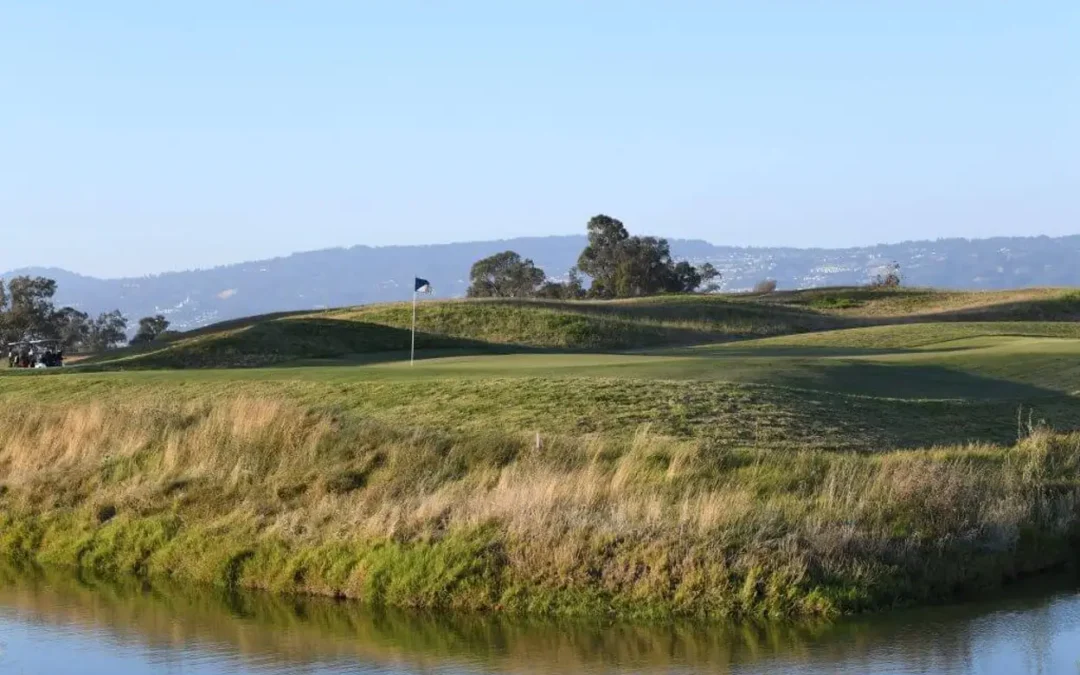
In Northern California, Corica Park is not only a public golf facility with 36 holes to challenge players of all skill levels, it is also an example of sustainability in action. With designs from ASGCA Past Presidents Rees Jones (South Course) and Robert Trent Jones, Jr. (North Course), Corica Park is unique in many ways.
The Athletic reports:
ALAMEDA, Calif. — Corica Park is a Northern California golf hub, but it is also a space where worlds collide, intersect and expand all at once, creating a property that can make an impact beyond the sport.
There’s ample evidence of this on a daily basis. On a Monday afternoon at Corica Park, you’ll find public golfers navigating the 118 bunkers and undulating greens that make up the South Course’s Australian Sandbelt-style routing. At the clubhouse, a local non-profit is meeting in the free-to-rent classroom. And on the North Course — closed to golfers one day each week — a birdwatching group is traversing the fairways, searching for Green Herons and Western Bluebirds.
Corica Park is home to two 18-hole layouts, a short course and a driving range, but the municipal property’s appeal isn’t limited to the reimagined Robert Trent Jones II North Course and the Rees Jones-designed South Course. Golfers and non-golfers alike come to the facility because it is organized to provide something for everyone. Corica Park blends into the Alameda ecosystem, from both a community and environmental perspective — a focus that is particularly important in California, where drought conditions and water scarcity are persistent challenges.
Kids play for free after 4 p.m. The course hosts regular women’s clinics and outings. Wellness events and yoga classes are regular programming. The open spirit of Corica Park can even be felt during San Francisco’s Fleet Week, when golfers get first-row seats to the U.S. Navy Blue Angels practicing their formations from the neighboring Oakland Airport.
“It’s gone from golf to more than golf,” says Tamara Sabella, Corica Park’s director of community engagement. “We’re not just bringing access to the game of golf, we’re bringing access to the space that is public land.”
With tee times ranging from $35 to $99 depending on time and day, Corica Park’s top-tier golf is just the baseline for a place that is evolving by the month. The holes twist and turn with dynamic contours on what feels like a relatively flat piece of property.
On the South, you’ll find those Australian-inspired rolling fairways, rebuilt by Rees Jones and Steve Weisser in 2018. On the North, you’ll come across design elements that are native to another golf mecca: Scotland. Pot bunkers are sprinkled throughout this shorter, compact routing that measures 6,382 yards from the back tees. Rees’ brother, Robert Trent Jones Jr., and Mike Gorman tweaked the front nine and completed a full renovation of the back nine in March 2025.
But the real highlight of Corica Park’s two courses is the greens: They roll consistently at an 11.5 on the Stimpmeter, thanks to long-time superintendent Vinny Paul, and double-breaking putts are not difficult to come by. They roll as true as any Bay Area country club.
The mission to make Corica Park into what it is today started in 2011. The City of Alameda accepted proposals from private groups to overhaul a deteriorating 333-acre facility. Originally founded in 1927, the local government just couldn’t keep up with Corica Park anymore.
Greenway Golf — a boutique golf course management company at the time — ultimately secured the lease after pledging to fully design, build, operate and maintain the property with a particular eye for the environment. The group had ambitious plans to make the course self-sustaining, a mission that felt appropriate for a California public green space. Despite some hurdles, the plan worked.
Greenway raised the property’s foundation approximately 11 feet in elevation with truckloads of repurposed but safe-to-use sand from a San Francisco construction project. They built ponds and storm runoff areas to capture water that could then be used to maintain the course on a loop.
The underground effort was coupled with an imported agronomy strategy. The greenway methodology for golf course maintenance derives from Australia, where the sport fits seamlessly and organically into the natural landscape. Royal Melbourne, one of the greatest golf courses in the world, and the greater Melbourne area inspired the sustainable Corica model.
Corica Park’s courses feature bent grass greens, which aren’t nearly as chemical-dependent as Poa annua. The fairways are Santa Ana Bermuda, a drought-tolerant strain. The bunkers are lined with recycled astroturf from the old driving range. There are 6,000 independent irrigation heads on the South Course alone, so Paul can pick and choose which specific areas need watering, rather than blindly turning on the spigot on an entire hole.
“Golf courses, for a while, were seen as beautiful green spaces but using a lot of chemicals and fertilizers,” says Ken Campbell, Corica Park’s general manager. “We really had this vision that we could bring environmental, sustainable maintenance practices with exceptional golf conditions at a municipal property.”
Marla Lee, who lives two minutes down the street from Corica Park and now serves as its sustainability manager, said the local coffee shop chatter was abuzz during construction. “Alameda hasn’t always been warm and fuzzy about golf courses,” she said.
That’s why her role was integral. Lee came in as a consultant for a new art installation and garden on the perimeter of the property that beautified an abandoned fire tower. Then the ideas started snowballing: Could Corica Park reintroduce native plants to its land? Could it develop pollinator sites? Attract new bird species?
The answer was yes, and the result meant a golf course that not only attracted serious and recreational players, but also created an environment that the local, non-golf community could actually get behind. The tables turned because the Corica maintenance team never questioned the effort. They believe that sustainable practice in the golf industry is increasingly important for the long-term viability of the sport amidst broader environmental concerns.
“Everything has to be intentional,” says Lee. “I said to Vinny Paul when I came on board, ‘Those two pesticides? You can’t use them. They’re bad for butterflies.’ And he said, ‘Ok!’”
Corica is serious about merging and including its surrounding community. Sustainability — and the messaging around those efforts — was integral to that process. Showing a care for the surrounding neighborhoods and environment opened the door for a new demographic at Corica Park, and the next step was making those individuals feel welcome once they were there.
“Just coming down the driveway is a barrier,” says Sabella. “I’ve met so many people who say, until they met me, I would have never entered this place. They don’t know it’s public. They don’t think they can access anything. They don’t know what to wear. They don’t know if they’re going to stand out. … You have to walk in and see representation and know that you’re wanted there.”
In addition to the course renovations, which were completed in a staggered manner over the last nine years, Corica Park also overhauled its golf shop with that message in mind.
Small businesses and brands local to the Bay Area are stocked, creating a unique urban flair to golf course hospitality. Every first Friday of the month, from March through October, Corica hosts a night of food trucks, music drinks and games to introduce the community to the courses and support local causes.
The 333-acre plot might be sprinkled with bunkers, tee boxes and fairways, but its management is acutely aware that it is a public green space at its core. Corica Park has figured out that the sport of golf and inclusive community resources do not have to be mutually exclusive.
“We have a common enthusiasm for a beautiful, sustainable space,” Campbell says. “If you’re really going to be a community space, you have to look beyond golf, and that’s where all these things come together.
“We think it’s a model that can be replicated.”